

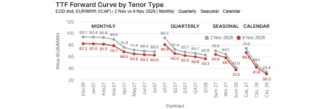
European gas prices moved materially lower across the entire forward curve between 2 and 9 November. The change was most pronounced in near-term winter contracts: January 2027 TTF declined from €93.7/MWh to €82.2/MWh, while the Q1 2027 contract fell from €92.2/MWh to €80.8/MWh.
It would be easy to interpret this as a broad improvement in Europe’s energy outlook. A more cautious reading is that the market removed part of its geopolitical risk premium while continuing to price a significant winter and near-term supply premium.
The broad-based repricing matters more than any single contract
Every contract displayed—from December 2026 through calendar 2029—was lower on 9 November than on 2 November. In percentage terms, the fall was ~12% in the front versus ~9% for calendar 2029.
That pattern suggests a change in the market’s assessment of risk across multiple delivery periods, rather than an isolated adjustment to one weather forecast or one physical balancing point. Near-term contracts reacted most because they contain the greatest immediate sensitivity to geopolitics, winter demand and LNG availability.
The external backdrop supports that interpretation. December delivery fell sharply over the same days as expectations of easing Middle East tensions and increased European regasification volumes reduced the immediate risk premium.
A lower curve does not mean supply risk has disappeared
The shape of the curve remains important. On 9 November, Q1 2027 was priced at €80.8/MWh, compared with €65.4/MWh for Q2 2027—a premium of €15.4/MWh. Part of this spread is normal seasonality (winter demand and storage carry); the supply-security premium is the excess over a typical winter-summer spread. Calendar 2027 remained at €66.9/MWh, well above calendar 2028 at €41.8/MWh and calendar 2029 at €30.3/MWh. The curve also drops sharply after winter 2027/28: Q4 2027 and Q1 2028 trade at €59.8 and €56.3/MWh, while Summer 2028 is at €37.3/MWh, implying the market expects tightness to persist through the winter before easing.
This indicates that the market was still attaching a substantial value to near-term supply security. EU gas storage was 73.0% full on 6 November, 18.6 percentage points below its five-year average, which helps explain why the winter premium persists even as prices fall. Another market update placed EU storage near 72% on 10 November, compared with a five-year seasonal average of 89, as colder weather accelerated withdrawals.
For utilities, trading desks and risk managers, therefore, the relevant question is not simply whether prices fell. It is whether the assumptions driving the decline—continued diplomacy, recovering LNG availability and manageable winter demand—remain valid.
Forward-curve transparency supports better risk decisions
A single front-month price can obscure how the market is distinguishing immediate disruption risk from longer-term supply conditions. A complete curve shows where the repricing is concentrated, how quickly risk decays across delivery periods and whether seasonal premiums remain elevated.
That distinction matters for hedging and valuation. Reducing a hedge because the prompt contract has fallen may be premature if the winter strip still embeds a substantial premium. Similarly, valuation controls should distinguish a broad change in the forward curve from temporary moves in the most liquid contract.
The November move suggests that geopolitical relief can reprice European gas rapidly. It does not establish that Europe’s winter supply balance has become comfortable. Transparent, observable forward pricing helps practitioners separate those two conclusions.
Request a Parameta Solutions data sample to explore the underlying TTF forward curve and related European gas pricing.
Disclaimer
© 2026 ICAP Information Services Limited (“IISL”). This communication is provided by ICAP Information Services Limited or a member of its group (“Parameta”) and all information contained in or attached hereto (the “Information”) is for information purposes only and is confidential. Access to the Information by anyone other than the intended recipient is unauthorised without Parameta’s prior written approval. The Information may not be not used or disclosed for any purpose without Parameta’s prior written approval, including without limitation, storing, copying, distributing, licensing, selling or displaying the Information, using the Information in an application or to create derived data of any kind, co-mingling the Information with any other data or using the data for any unlawful purpose of for any purpose that would cause it to become a benchmark under any law, regulation or guidance. The Information is not, and should not be construed as, a live price, an offer, bid, recommendation or solicitation in relation to any financial instrument or investment or to participate in any particular trading strategy or constituting financial or investment advice or a financial promotion. The Information does not constitute a public offer under any applicable legislation or an offer to sell or a solicitation of an offer to buy any securities. The Information is not to be relied upon for any purpose whatsoever and is provided “as is” without warranty of any kind, either expressly or by implication, including without limitation as to completeness, timeliness, accuracy, continuity, merchantability or fitness for any particular purpose. All representations and warranties are expressly disclaimed, to the fullest extent possible under applicable law. In no circumstances will Parameta be liable for any indirect or direct loss, or consequential loss or damages including without limitation, loss of business or profits arising from the use of or any inability to use the Information, or any inaccuracy in the Information. Parameta may suspend, withdraw or modify or change the terms of the provision of the Information at any time in its sole discretion, without notice. All rights, including without limitation intellectual property rights, in and to the Information are, and shall remain, the property of IISL or its licensors. Use of, access to or delivery of Parameta’s products and/or services requires a prior written licence from Parameta or its relevant affiliates. The terms of this disclaimer are governed by the laws of England and Wales.
Latest Insights
See All
What an extreme WTI-Brent discount may be signalling

Parameta Solutions and Zema Global expand access to trusted OTC energy and commodities data