

The most useful market information is not always found in outright prices. Sometimes it emerges in the relationship between benchmarks.
The latest WTI-Brent spread chart shows the differential trading near the lower end of its historical range, moving beyond the -3 standard deviation band relative to its recent average. The spread is currently considerably more negative than its long-run mean of approximately -4.6 $/bbl, highlighting an unusually large premium for Brent relative to WTI.
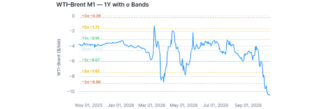
For market participants, the significance extends well beyond crude oil. Large moves in benchmark relationships often provide insight into market structure, supply-chain risk, hedging effectiveness and valuation challenges that outright price movements alone cannot reveal.
Sometimes the spread matters more than the oil price
WTI and Brent are often discussed as interchangeable indicators of the oil market. In practice, they represent different underlying exposures.
Brent is the benchmark most closely associated with seaborne international crude flows, while WTI reflects a market supported by substantial domestic U.S. production and export capacity. When the spread between the two benchmarks moves sharply, it often suggests that market participants are repricing specific risks rather than simply reassessing the outlook for oil demand or supply in aggregate.
The current observation highlights an important point: relative value relationships can be more informative than outright prices when trying to understand how risk is being distributed across markets.
Geopolitical risk does not affect all benchmarks equally
One explanation frequently discussed by market participants is concern about potential disruption to shipping through the Strait of Hormuz.
A significant share of global oil exports moves through this route. If traders assign a higher probability to disruption, the impact is unlikely to be uniform across crude benchmarks.
Brent is widely used as the reference benchmark for internationally traded crude. As a result, concerns about seaborne supply availability can lead market participants to price a larger geopolitical premium into Brent-linked markets.
WTI may also strengthen under such a scenario. However, because U.S. crude production is geographically removed from the region and the United States is itself a major producer and exporter, WTI can be perceived as relatively insulated from the immediate physical disruption. In some cases, U.S. barrels may even become more attractive substitutes for potentially disrupted supplies.
The result is a widening Brent premium relative to WTI, causing the WTI-Brent spread to become increasingly negative.
While any particular market move can reflect multiple factors, the key observation is that benchmark differentials frequently embed information about perceived supply-chain risk that outright crude prices may only partially capture.
Extreme spread moves create practical challenges for risk management
When benchmark spreads approach historically unusual levels, basis risk becomes increasingly important.
Many physical and financial market participants hedge exposure in one benchmark while holding risk in another. Under normal conditions this relationship may be relatively stable. However, periods of spread dislocation can reveal hidden exposures that are not visible when focusing exclusively on outright crude prices.
The implications can extend to valuation, stress testing, risk limits and performance attribution. Two portfolios with similar directional oil exposure may experience materially different outcomes if one contains significant Brent-WTI basis exposure.
This is where transparent and observable market data becomes particularly valuable. Understanding whether risk originates from outright commodity prices or from changing benchmark relationships can help market participants construct more effective hedges and develop more robust valuation frameworks.
Looking beyond the headline oil price
The current WTI-Brent spread serves as a reminder that market structure often matters as much as market direction.
For traders, risk managers and valuation teams, monitoring benchmark relationships can provide insight into changing risk perceptions, supply-chain concerns and relative-value opportunities that may not be apparent in outright prices alone.
Request a sample of Parameta Solutions energy and commodities market data to explore crude oil benchmark spreads, relative-value relationships and OTC energy market pricing in greater detail. Parameta Solutions provides OTC energy and commodities market data across crude oil, refined products, gas and power markets.
Disclaimer
© 2026 ICAP Information Services Limited (“IISL”). This communication is provided by ICAP Information Services Limited or a member of its group (“Parameta”) and all information contained in or attached hereto (the “Information”) is for information purposes only and is confidential. Access to the Information by anyone other than the intended recipient is unauthorised without Parameta’s prior written approval. The Information may not be not used or disclosed for any purpose without Parameta’s prior written approval, including without limitation, storing, copying, distributing, licensing, selling or displaying the Information, using the Information in an application or to create derived data of any kind, co-mingling the Information with any other data or using the data for any unlawful purpose of for any purpose that would cause it to become a benchmark under any law, regulation or guidance. The Information is not, and should not be construed as, a live price, an offer, bid, recommendation or solicitation in relation to any financial instrument or investment or to participate in any particular trading strategy or constituting financial or investment advice or a financial promotion. The Information does not constitute a public offer under any applicable legislation or an offer to sell or a solicitation of an offer to buy any securities. The Information is not to be relied upon for any purpose whatsoever and is provided “as is” without warranty of any kind, either expressly or by implication, including without limitation as to completeness, timeliness, accuracy, continuity, merchantability or fitness for any particular purpose. All representations and warranties are expressly disclaimed, to the fullest extent possible under applicable law. In no circumstances will Parameta be liable for any indirect or direct loss, or consequential loss or damages including without limitation, loss of business or profits arising from the use of or any inability to use the Information, or any inaccuracy in the Information. Parameta may suspend, withdraw or modify or change the terms of the provision of the Information at any time in its sole discretion, without notice. All rights, including without limitation intellectual property rights, in and to the Information are, and shall remain, the property of IISL or its licensors. Use of, access to or delivery of Parameta’s products and/or services requires a prior written licence from Parameta or its relevant affiliates. The terms of this disclaimer are governed by the laws of England and Wales.