
Geopolitical risk has always influenced oil markets. What has fundamentally changed is the speed and location of price discovery. Recent headlines have brought renewed focus to energy chokepoints and shipping risk. Even without a physical disruption, changes in perceived risk can drive sharp intraday moves across crude, distillates, and refinery cracks. In these conditions, delayed or static pricing quickly becomes a constraint on decision making.
‘Oil prices no longer adjust through a slow, linear chain from geopolitical headlines to fundamentals and then to futures. Instead, modern oil markets reprice almost instantly through OTC channels, with movements rippling across crude, distillates, fuel oil, and crack spreads in real time’, A Mixture of Stress and Relief, PVM.
The key point here is that the goal isn’t to forecast geopolitical events themselves. Instead, it’s to recognise that once these shocks happen, the market now reacts so quickly that intraday OTC visibility is essential to understanding what’s really moving prices. In today’s market structure, the gap between understanding a move and missing it can be only minutes.
Geopolitics and the compression of time in oil markets
Historically, geopolitical shocks tended to appear first in flat price moves in headline crude benchmarks. As PVM has observed, that sequencing has broken down. Today, oil price discovery begins with curves, spreads, and relative value relationships, as market participants rapidly reassess prompt supply, freight routes, refinery margins, and regional dislocations.
This shift reflects a structural compression of time in global oil markets. What once unfolded over multiple trading sessions now occurs intraday, sometimes within a single news cycle. The implication is clear: decision windows have narrowed, while exposure has not.
Why modern oil price discovery starts in OTC markets
The earliest signals of geopolitical stress increasingly emerge in OTC oil markets rather than on exchange screens. Three forces explain this evolution:
- Curves move before flat prices: Geopolitical repricing often begins with prompt spreads, time spreads, and cracks, not outright crude benchmarks.
- Liquidity is situational, not static: During periods of stress, liquidity migrates rapidly across products and instruments as participants transfer risk.
- OTC flows reveal intent: Brokered markets absorb and transmit geopolitical risk faster than delayed or end of day pricing systems can reflect.
How geopolitical shocks propagate across the oil barrel
- Shipping and transit disruptions impact middle distillates first, particularly diesel, gasoil, and freight linked cracks.
- When Panama Canal congestion extended transit times by 7–10 days, the impact was felt immediately in prompt diesel availability. ULSD cracks widened by roughly $4–6/BBL well before any meaningful move appeared in headline crude benchmarks, highlighting how logistics stress is priced first in refined products. (Source)
- Prompt spreads react ahead of outright benchmarks, signalling immediate supply concerns rather than longer term balance shifts.
- A single hydrocracker outage removing around 50–70 kb/d of local diesel supply can push the ICE gasoil M1–M2 time spread wider by $10–15/tonne within minutes. These adjustments typically occur long before outright futures prices respond, as the market prioritises near‑term availability over flat price direction. (Source)
- Volatility clusters reshape curves intraday, affecting hedging efficiency, margining, and risk metrics in real time.
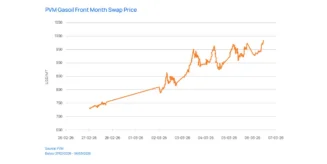
- During periods of heightened geopolitical stress, intraday gasoil price swings of 5–7% are not unusual. As the forward curve repeatedly re‑prices within a single session, margin requirements can rise to two- or three-times normal levels, forcing risk adjustments in real time rather than at the close. (Source)
Geopolitical shocks now travel both horizontally across products and vertically across tenors, reinforcing that geopolitical risk is a cross-barrel phenomenon rather than a single price event (PVM).
Volatility is no longer confined to the front screen
When geopolitical risk rises, market impact rarely stays limited to outright crude benchmarks. Freight assumptions, routing uncertainty, and prompt availability are reassessed quickly, and the effects ripple through gasoil, gasoline, jet, fuel oil, and cracks.
What changes is not just price level, but speed:
- Curves shift intraday
- Liquidity migrates between instruments
- Risk exposures move faster than end of day processes can track
In this environment, firms relying on delayed snapshots or fragmented OTC signals are reacting after the market has already moved.
Why real time matters now
When the market is moving on headlines, the core requirement isn’t just speed, it’s trusted speed. Real-time inputs that are broker-sourced and time-stamped can help firms answer three questions continuously:
- What changed? (price levels, spreads, cracks)
- How quickly is it changing? (intraday volatility and curve shifts)
- Is it actionable? (confidence in provenance, auditability, and workflow integration)
Parameta’s Real-Time Oil OTC data is designed around that reality: execution-grade, broker-sourced mid-prices across the barrel: crude, light ends, middle distillates, fuel oil, and LPG, delivered to match modern workflows.
Coverage is built from leading brokerage desks (PVM, ICAP, and TP), with delivery through Fusion Insights (TP ICAP’s flagship data intelligence platform) and enterprise-friendly channels (e.g., streaming and cloud/snapshot options) so teams can integrate real-time pricing into their systems rather than monitoring it manually. The service is designed for real-time use during brokerage hours (weekdays), aligning with how intraday risk is actually managed when the tape accelerates.
Where real-time OTC pricing supports decisions today
- Traders use real-time broker-sourced pricing to monitor rapid repricing, spot dislocations, and react to shifting liquidity when headline risk dominates.
- Risk managers need up-to-the-minute marks to track exposures, run scenarios, and reduce “latency risk” when volatility jumps across the curve.
- Analysts and quants benefit from high-granularity data for model validation, regime detection, and intraday insight generation—particularly valuable when market structure changes faster than end-of-day processes can reflect.
Why visibility matters when markets move fast
Geopolitical uncertainty doesn’t just move oil prices; it compresses decision windows.
When markets reprice on headlines, the difference between reacting and anticipating often comes down to data latency. Realtime, broker-sourced OTC pricing helps firms see market moves as they happen, not after they’ve already been absorbed into the curve.
If you’d like to see how real-time broker-sourced pricing looks in practice, across benchmarks, distillates, and cracks, Parameta Solutions can provide a data sample and walk through delivery options via Fusion Insights or direct feeds.
Note: This article is for informational purposes and does not constitute investment advice.
Parameta Solutions is a leading specialist in OTC Oil market data. Sourced exclusively from the trading desks of TP ICAP, we deliver high quality, independent data to buy side and sell side institutions.
- Unmatched barrel coverage: Crude, light ends, middle distillates, fuel oil and LPG, backed by data from three of the world’s largest oil brokers.
- Execution‑grade, real‑time pricing: Broker‑sourced mid‑prices designed to support fast, accurate decision‑making.
To access more information about our Energy & Commodities data solutions, please contact us for a data sample or further information.
Bibliography
Bibliography
PVM Oil Associates, A Mixture of Stress and Relief
Read SourcePVM Oil Associates, PVM Market & Broker Data
Read SourceU.S. Energy Information Administration (EIA), Petroleum prices reacted to economic and geopolitical uncertainty in the second quarter
Read SourceWindward, The Restricted Panama Canal’s Global Impact
Read SourceMNI Markets, Prompt Diesel Spread at Highest Since April Suggesting Tight Market
Read SourceUNCTAD, Global trade disruptions, shipping delays, and chokepoint impacts
Read SourceMcKinsey & Company, Supply chain delays, cost inflation, and geopolitical risk analysis
Read SourceInvezz, Diesel crack strength and refined product market commentary / Gasoil tightness and crack spread dynamics
Read SourceICE (Intercontinental Exchange), Market structure, contracts, and rulebook
Read SourceOilPrice.com, Refined product volatility and multi‑day price swings
Read SourceBlackRock, Risk dashboards, market stress indicators, and macro risk frameworks
Read SourceDisclaimer
© 2026 ICAP Information Services Limited (“IISL”). This communication is provided by ICAP Information Services Limited or a member of its group (“Parameta”) and all information contained in or attached hereto (the “Information”) is for information purposes only and is confidential. Access to the Information by anyone other than the intended recipient is unauthorised without Parameta’s prior written approval. The Information may not be not used or disclosed for any purpose without Parameta’s prior written approval, including without limitation, storing, copying, distributing, licensing, selling or displaying the Information, using the Information in an application or to create derived data of any kind, co-mingling the Information with any other data or using the data for any unlawful purpose of for any purpose that would cause it to become a benchmark under any law, regulation or guidance. The Information is not, and should not be construed as, a live price, an offer, bid, recommendation or solicitation in relation to any financial instrument or investment or to participate in any particular trading strategy or constituting financial or investment advice or a financial promotion. The Information does not constitute a public offer under any applicable legislation or an offer to sell or a solicitation of an offer to buy any securities. The Information is not to be relied upon for any purpose whatsoever and is provided “as is” without warranty of any kind, either expressly or by implication, including without limitation as to completeness, timeliness, accuracy, continuity, merchantability or fitness for any particular purpose. All representations and warranties are expressly disclaimed, to the fullest extent possible under applicable law. In no circumstances will Parameta be liable for any indirect or direct loss, or consequential loss or damages including without limitation, loss of business or profits arising from the use of, any inability to use, or any inaccuracy in the Information. Parameta may suspend, withdraw or modify or change the terms of the provision of the Information at any time in its sole discretion, without notice. All rights, including without limitation intellectual property rights, in and to the Information are, and shall remain, the property of IISL or its licensors. Use of, access to or delivery of Parameta’s products and/or services requires a prior written licence from Parameta or its relevant affiliates. The terms of this disclaimer are governed by the laws of England and Wales.