

Carry and options skew answer different questions. Carry estimates what a position earns from the rate differential if other conditions are unchanged. A 25-delta risk reversal compares the implied volatility of out-of-the-money USD calls with USD puts, showing which directional hedge commands the higher price.
The chart brings those measures together across nine currencies. It also uses colour to place today’s skew within its one-year range. That combination helps distinguish a directional market signal from a protection price shaped by hedging demand and the expected size and speed of adverse moves.
Key observation: USD/EUR offers about +1.6% annualized carry and a +0.60 risk reversal, while its USD-call skew is at the 86th percentile of the past year. Carry and protection pricing align, but the hedge is expensive by recent standards.
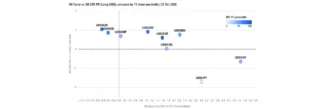
USD/EUR combines positive carry with historically rich dollar protection
USD/EUR sits in the upper-right quadrant. Being long USD against EUR earns about +1.6% annualized carry over the three-month horizon, while the +0.60 risk reversal indicates that USD calls are more expensive than USD puts. The market is therefore charging more to hedge a stronger dollar than a weaker one.
The colour provides the more distinctive information. At the 86th percentile, the skew is near the upper end of its one-year range, which ran from about -1.2 to +1.2 when expressed in EUR/USD terms, with the sign reversed for the USD/EUR convention. The skew is not only positive; it is expensive relative to most of the past year.
A protection price should not be mistaken for a forecast
Carry and skew both point towards the dollar, but they describe pricing rather than certainty. A rich USD-call skew can reflect demand for protection, the distribution of recent moves and the cost of providing liquidity. It does not establish that USD/EUR will rise.
USD/JPY illustrates why the two measures need to be read together. It offers about 3% positive carry, yet its sixth-percentile skew shows that protection against a yen surge is near its most expensive level of the year. The income signal and the options signal conflict, highlighting the crash risk that can sit behind an apparently attractive carry trade.
Rich skew changes how a dollar view may be implemented
For a participant seeking USD/EUR exposure, the relevant decision is not simply whether to be long the dollar. It is whether the expected benefit justifies the price of the chosen instrument. An outright position or forward captures the positive carry without paying the elevated premium embedded in USD calls, but leaves the position exposed to adverse spot moves.
Options retain defined-risk characteristics, yet buying USD calls when skew is at the 86th percentile means paying a historically rich relative price. Participants who believe the stronger-dollar tail is already fully reflected may instead evaluate structures that reduce the skew premium, such as call spreads, or carefully risk-managed strategies that sell part of the expensive skew. Those approaches introduce different payoff limits and option-selling risks, so scenario analysis, liquidity and risk limits remain essential.
Observable carry, risk-reversal and historical-percentile data allow traders, hedgers and valuation teams to compare these trade-offs consistently. Transparency matters because the same directional view can produce materially different outcomes depending on how carry, premium, skew and tail exposure are combined.
The central lesson is that aligned carry and skew do not end the analysis; they move it to implementation. For USD/EUR, the dollar earns carry and dollar-up protection is strongly bid, making the cost and structure of the hedge as important as the directional view.
Request a sample of Parameta Solutions FX options data to explore carry, risk reversals and historical skew positioning across currency pairs.
Disclaimer
© 2026 ICAP Information Services Limited (“IISL”). This communication is provided by ICAP Information Services Limited or a member of its group (“Parameta”) and all information contained in or attached hereto (the “Information”) is for information purposes only and is confidential. Access to the Information by anyone other than the intended recipient is unauthorised without Parameta’s prior written approval. The Information may not be not used or disclosed for any purpose without Parameta’s prior written approval, including without limitation, storing, copying, distributing, licensing, selling or displaying the Information, using the Information in an application or to create derived data of any kind, co-mingling the Information with any other data or using the data for any unlawful purpose of for any purpose that would cause it to become a benchmark under any law, regulation or guidance. The Information is not, and should not be construed as, a live price, an offer, bid, recommendation or solicitation in relation to any financial instrument or investment or to participate in any particular trading strategy or constituting financial or investment advice or a financial promotion. The Information does not constitute a public offer under any applicable legislation or an offer to sell or a solicitation of an offer to buy any securities. The Information is not to be relied upon for any purpose whatsoever and is provided “as is” without warranty of any kind, either expressly or by implication, including without limitation as to completeness, timeliness, accuracy, continuity, merchantability or fitness for any particular purpose. All representations and warranties are expressly disclaimed, to the fullest extent possible under applicable law. In no circumstances will Parameta be liable for any indirect or direct loss, or consequential loss or damages including without limitation, loss of business or profits arising from the use of or any inability to use the Information, or any inaccuracy in the Information. Parameta may suspend, withdraw or modify or change the terms of the provision of the Information at any time in its sole discretion, without notice. All rights, including without limitation intellectual property rights, in and to the Information are, and shall remain, the property of IISL or its licensors. Use of, access to or delivery of Parameta’s products and/or services requires a prior written licence from Parameta or its relevant affiliates. The terms of this disclaimer are governed by the laws of England and Wales.
Latest Insights
See All
How Parameta Solutions Transforms Sparse Market Data into Consistent, Actionable Insights

10 Reasons Why Market Data Teams Are Moving from SFTP to Snowflake
