

OTC pricing data
A key challenge in OTC markets is that observable trading activity is often fragmented and unevenly distributed. Activity tends to concentrate in the most liquid instruments, while many parts of the market trade infrequently.
However, market participants still need complete, consistent data sets to support workflows such as valuation, risk modelling and analytics.
This is why different forms of pricing data exist. They represent different approaches to:
- capturing observable activity
- supplementing gaps
- transforming raw data into usable outputs
To understand these differences, it is helpful to think in terms of a pricing spectrum, which reflects how close a given data set is to underlying market activity.
The OTC pricing data spectrum
The simplest way to understand OTC pricing data is as a spectrum.
At one end is raw market evidence, derived directly from trading activity. At the other is highly processed data, built from aggregated or modelled inputs. Understanding where a data set sits on this spectrum is essential when assessing its suitability for trading, valuation and risk workflows.
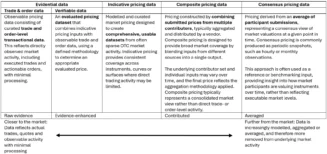
This spectrum is not about one type of data being “better” than another. Rather, it reflects different trade-offs between:
- observability vs coverage
- accuracy vs completeness
- raw data vs usability
Understanding where a data set sits on this spectrum is essential when assessing how it should be used.
Trade & order pricing data
Trade and order pricing data is sourced directly from broker-handled transactions and pre-trade activity, capturing:
- executed trades
- live bids and offers
- observable order flow
Because it reflects actual market activity, evidential data provides the strongest form of pricing evidence. It is commonly used in use cases where independence and auditability are critical, such as:
- independent price verification (IPV)
- valuation control
- regulatory reporting
- market surveillance
At Parameta, trade and order data is sourced directly from TP ICAP’s global broking network, with coverage across capital markets and energy & commodities.
Verifiable pricing data
Verifiable pricing data sits one step further along the spectrum. It addresses a key limitation of raw evidential data: while highly accurate, observable activity can be sparse, particularly across less liquid instruments or tenors.
At Parameta, verifiable pricing helps to bridge this liquidity gap by combining:
- observable trade and order data
- indicative broker pricing
- a defined methodology and rules-based approach
to produce calculated bid, mid and ask prices. With Parameta verifiable data, prices are derived using a transparent methodology, outputs are supported by underlying transactional evidence, and additional statistics provide insight into how the price was formed.
The result is a data set that is:
- more complete than raw data
- anchored in observable activity
- transparent and defensible for audit purposes
A simple way to think about this distinction:
- observable data = what the market did or showed
- verifiable data = an evaluated price built from observable data, indicative inputs and methodology
Indicative pricing data
Indicative pricing plays a central role in OTC markets, particularly in areas where observable trading activity is limited.In many OTC markets, activity is not continuous. It is often concentrated in the most liquid instruments, maturities or strikes, with large parts of the market trading infrequently or not at all during certain periods.
However, market participants still require complete and consistent pricing coverage across:
- full curves
- volatility surfaces
- instrument sets and tenors
to support workflows such as trading, valuation, risk management and analytics.
Indicative pricing exists to bridge this gap.
Indicative pricing remains one of the most widely used forms of OTC pricing data because it enables market participants to move from fragmented observations to a usable, consistent view of the market.
From sparse activity to usable data
Indicative pricing takes limited observable market inputs and transforms them into decision-ready data sets.
This typically involves:
- selecting relevant market inputs, including broker quotes, trades and order flow
- applying modelling, interpolation and extrapolation techniques
- ensuring consistency across instruments, maturities and structures
- applying data quality controls and validation checks
The result is not simply a collection of prices, but a structured representation of the market, even where direct activity is limited.
A simple way to think about this:
- observable data is sparse and incomplete
- indicative pricing creates completeness and usability
What indicative pricing actually represents
Indicative pricing is sometimes misunderstood as being less reliable than transactional data. In practice, it serves a different purpose.
Rather than attempting to replicate individual trades, indicative pricing provides:
- a dealer-informed view of where the market is
- a consistent pricing framework across instruments
- a continuous view of market conditions, even when trading is intermittent
This is why it is widely used in workflows that require coverage and consistency at scale, such as:
- portfolio valuation and monitoring
- risk modelling and VaR calibration
- scenario analysis and stress testing
- intraday market tracking
What drives the quality of indicative pricing
The quality of indicative pricing is not defined by the output alone, but by how it is constructed.
Key factors include:
- Source data: pricing anchored in real trading activity and broker interaction is more likely to reflect true market conditions
- Methodology: the approach used to select inputs, model gaps and maintain consistency across datasets
- Transparency: the ability to understand and interrogate how prices are formed
- Data quality controls: ongoing validation, cleansing and monitoring processes
These factors determine whether indicative pricing is simply a theoretical approximation, or a robust representation of the market.
The role of indicative pricing in practice
In practice, indicative pricing acts as a core dataset across OTC workflows, rather than a supplementary one.
- Firms rely on it because it provides:
- breadth and depth across asset classes and instruments
- consistency across time series and structures
- availability in real time, intraday and historical formats
- integration into trading, risk and analytics systems
At Parameta, indicative pricing is anchored in broker activity from TP ICAP, reflecting a significant share of global OTC liquidity in certain markets. This helps ensure the pricing reflects real underlying conditions, while still delivering the coverage required for large-scale use.
Indicative data can be delivered as:
- prices and yields
- curves and volatility surfaces
- cash prices and differentials
- real-time, intraday and historical datasets
How indicative pricing fits within the spectrum
Within the broader pricing spectrum:
- evidential data provides direct market observations
- indicative pricing provides complete and usable coverage
- evaluated or verifiable data combines both approaches
- composite and consensus data sit further downstream
Indicative pricing is therefore rarely used in isolation. It typically forms the foundation layer, combined with other data types depending on the use case.
Composite pricing
Composite pricing data is constructed by blending submitted prices from multiple contributors into a single output, typically aggregated and distributed by a vendor. These data sets are designed to provide broad market coverage, but rely on contributor panels and aggregated inputs rather than direct access to underlying trading activity.
As a result:
- visibility into contributors and inputs is often limited
- underlying trades and order depth are not typically observable
- methodology may not be fully transparent
Within the pricing spectrum, composite data represents a more processed view of the market, sitting further from direct price formation.
Consensus pricing
Consensus pricing data represents an average of prices or valuations submitted by market participants. Rather than reflecting observable market activity, it provides a summarised view of where participants believe the market is at a given point in time.
Key characteristics include:
- periodic snapshots, such as monthly or intraday submissions
- reliance on participant marks rather than executed trades
- potential for convergence towards the average over time
For this reason, consensus data is typically used as a reference or validation point, rather than a primary source of pricing.
Within the spectrum, it sits at the furthest end, representing the most processed form of pricing data.
Bringing the spectrum together
Each type of OTC pricing data plays a different role within market workflows.
- trade and order data provides direct, observable evidence of market activity
- verifiable pricing builds on that evidence to create defensible, evaluated outputs
- indicative pricing delivers the complete, consistent coverage required for large-scale use
These categories represent data that is closest to the point of price formation.
Further along the spectrum:
- composite data provides aggregated views based on contributor inputs
- consensus data provides averaged views of participant valuations
Understanding these distinctions is critical when selecting pricing data, as the level of processing directly impacts transparency, observability and suitability for different use cases.
FAQs
What are the different types of OTC pricing data
OTC pricing data generally falls into five categories: trade and order data, verifiable or evaluated pricing, indicative pricing, composite pricing and consensus pricing. These types sit on a spectrum from raw market activity through to increasingly processed and aggregated data, with each serving different use cases.
What is the difference between indicative and transactional pricing
Transactional pricing is based on actual executed trades and observable market activity. Indicative pricing uses broker inputs, modelling and methodology to provide a continuous and usable view of the market, particularly where trading activity is limited or uneven. In practice, transactional data provides direct evidence, while indicative pricing provides coverage and consistency at scale.
What is verifiable or evaluated pricing data
Verifiable or evaluated pricing data combines observable trade and order data with indicative inputs and a defined methodology to produce calculated bid, mid and ask prices. This approach is designed to deliver pricing that is transparent, defensible and suitable for valuation, audit and regulatory use cases.
What is composite vs consensus pricing
Composite pricing is created by blending submitted prices from multiple contributors into a single output, typically using vendor‑defined methodology. Consensus pricing represents an average of participant valuations submitted at a point in time. Both sit further from direct market activity and are commonly used as supplementary or reference data rather than primary pricing sources.
Why is indicative pricing important in OTC markets
Indicative pricing is important because trading activity in OTC markets is often sparse or fragmented. It provides complete and consistent pricing coverage across instruments, curves and tenors, enabling trading, valuation and risk workflows to function even when observable market activity is limited.
Which OTC pricing data should I use for valuation
Valuation typically requires a combination of data types. Trade and order data provides observable market evidence, while indicative pricing provides the coverage needed across less liquid instruments. Verifiable or evaluated pricing brings these together to support transparent and defensible valuations, particularly for audit and regulatory purposes.
Disclaimer
© 2026 ICAP Information Services Limited (“IISL”). This communication is provided by ICAP Information Services Limited or a member of its group (“Parameta”) and all information contained in or attached hereto (the “Information”) is for information purposes only and is confidential. Access to the Information by anyone other than the intended recipient is unauthorised without Parameta’s prior written approval. The Information may not be not used or disclosed for any purpose without Parameta’s prior written approval, including without limitation, storing, copying, distributing, licensing, selling or displaying the Information, using the Information in an application or to create derived data of any kind, co-mingling the Information with any other data or using the data for any unlawful purpose of for any purpose that would cause it to become a benchmark under any law, regulation or guidance. The Information is not, and should not be construed as, a live price, an offer, bid, recommendation or solicitation in relation to any financial instrument or investment or to participate in any particular trading strategy or constituting financial or investment advice or a financial promotion. The Information does not constitute a public offer under any applicable legislation or an offer to sell or a solicitation of an offer to buy any securities. The Information is not to be relied upon for any purpose whatsoever and is provided “as is” without warranty of any kind, either expressly or by implication, including without limitation as to completeness, timeliness, accuracy, continuity, merchantability or fitness for any particular purpose. All representations and warranties are expressly disclaimed, to the fullest extent possible under applicable law. In no circumstances will Parameta be liable for any indirect or direct loss, or consequential loss or damages including without limitation, loss of business or profits arising from the use of or any inability to use the Information, or any inaccuracy in the Information. Parameta may suspend, withdraw or modify or change the terms of the provision of the Information at any time in its sole discretion, without notice. All rights, including without limitation intellectual property rights, in and to the Information are, and shall remain, the property of IISL or its licensors. Use of, access to or delivery of Parameta’s products and/or services requires a prior written licence from Parameta or its relevant affiliates. The terms of this disclaimer are governed by the laws of England and Wales.
Latest Insights
See All
How Parameta Solutions Transforms Sparse Market Data into Consistent, Actionable Insights

10 Reasons Why Market Data Teams Are Moving from SFTP to Snowflake
