

As headline inflation continues to cool, after heating up during the second half of 2021 and running red hot through 2022, we look at how the two most commonly used instruments offering direct exposure to inflation have performed during the recent inflationary period: inflation-linked bonds and inflation swaps. Before comparing them, it helps to define two terms that sit at the centre of this analysis.
What Is Breakeven Inflation?
Breakeven inflation is the market’s implied expectation of average inflation over a given period. In the bond market, it is the gap between the yield on a nominal government bond and the yield on an inflation-linked bond of the same maturity. In the swap market, it is the fixed rate on a zero-coupon inflation swap of that tenor, which is why swap-implied breakevens are widely watched as a cleaner, tenor-specific read of inflation expectations.
It is called “breakeven” because it is the inflation rate at which an investor would earn the same return from either bond. If realised inflation comes in above the breakeven rate, the inflation-linked bond outperforms; if it comes in below, the nominal bond does. In practice, breakevens also carry an inflation risk premium and liquidity effects, so they are a market-implied measure rather than a pure forecast.
How the breakeven inflation rate is calculated
Using bond yields, the calculation is a simple subtraction:
Breakeven inflation rate = nominal bond yield minus real (inflation-linked) bond yield
For example, if a 10-year nominal government bond yields 2.60% and a 10-year inflation-linked bond yields 0.40%, the 10-year breakeven inflation rate is 2.20%. This relationship is an application of the Fisher equation, which links nominal interest rates, real interest rates and expected inflation. The figures here are illustrative only.
What Is an Inflation Swap?
An inflation swap is a derivative contract in which one party pays a fixed rate and the other pays a rate linked to realised inflation, both calculated on an agreed notional amount. The inflation leg is referenced to an official price index, such as the euro area HICP excluding tobacco, UK RPI or US CPI. Because no principal changes hands at the start, inflation swaps give investors exposure to inflation without having to fund a bond position.
Inflation swaps come in several forms: zero-coupon inflation swaps (ZCIS), real rate swaps and year-on-year (YoY) swaps. ZCIS are considered pure inflation instruments, and are the most common form of inflation swap given their simple structure, in which the exchange of cash flows occurs only at maturity: a compounded fixed payment is exchanged for a variable payment linked to cumulative accrued inflation.
Inflation-Linked Bonds vs Inflation Swaps: Performance in the Recent Inflation Cycle
There is published literature analysing the suitability of inflation-linked bonds as a hedge against inflation in diversified portfolios, if not held to maturity, compared with inflation swaps. The table below summarises the key structural differences before we look at how each performed.
| Inflation-linked bonds | Zero-coupon inflation swaps (ZCIS) | |
| Funding | Funded: requires cash to buy the bond | Unfunded: no upfront principal |
| Main return drivers | Coupon, inflation accretion, and capital gains or losses from moves in real yields | Changes in inflation expectations versus the strike rate, and the inflation risk premium |
| Sensitivity to real interest rates | High, especially at long maturities | Largely isolated from real yield moves |
| Cash flows | Periodic coupons plus inflation-adjusted principal | A single exchange at maturity |
| Tenor flexibility | Limited to bonds in issue | Can be struck at the tenor required |
| Typical use | Direct holding in a portfolio | Overlay on existing portfolios or assets |
Why rising rates hit inflation-linked bond prices
Returns from holding inflation-linked bonds are driven by:
- Coupon rate
- Capital appreciation or depreciation
- Inflation accretion over the holding period
The primary component of total returns for a long-duration inflation-linked bond, however, tends to be capital appreciation or depreciation driven by moves in real yields. Real yields are the returns a bond investor earns from interest payments adjusted for inflation, and are usually calculated by deducting the expected inflation rate from the nominal yield [1].
Although rising inflation increases the inflation accretion component of returns, it usually supports tighter monetary policy and rising nominal interest rates, causing a fall in the capital value of bonds, including inflation-linked bonds. Longer-maturity bonds are usually affected more, based on the market’s expectation of long-term interest rates.
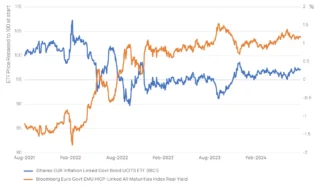
As the chart below shows, the 10-year real yield moved from negative to positive territory, and this is reflected in the performance of the iShares EUR Inflation Linked Govt Bond UCITS ETF.
How Zero-Coupon Inflation Swaps (ZCIS) Work
In a ZCIS, the fixed payer agrees at the outset to pay a fixed inflation rate, compounded over the life of the swap, in exchange for receiving the actual cumulative change in the reference price index. Both legs are netted and settled once, at maturity. The fixed rate agreed at the start is the swap-implied breakeven inflation rate for that tenor.
Returns from a ZCIS are driven mainly by:
- Changes in inflation expectations compared with those at the time of striking the swap
- The inflation risk premium
ZCIS are typically used as an overlay on existing portfolios or assets and, being derivatives, they offer:
- Capital efficiency, as cash does not need to be allocated
- Flexibility in managing differing maturities and tenors
- Information about market-implied inflation, which is reflected in swap valuations
Parameta’s Breakeven Inflation Swap Indices (BISI)
Parameta Solutions’ Breakeven Inflation Swap Indices (BISI) provide an indicative measure of the returns from investing in an unfunded, monthly rolling ZCIS. BISI are designed to be investable indices that:
- Maintain “constant maturity” from one month to the next
- Effectively “lock in” the returns generated from changes in inflation expectations during the month
Because BISI track swap-implied breakevens at a fixed tenor, they offer a consistent, rules-based view of how inflation expectations are moving. Find out more about Parameta’s benchmarks and indices and the inflation derivatives data behind them, or download the EUX BISI factsheet.
BISI Performance vs Inflation-Linked Bond ETFs
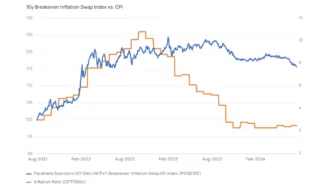
As eurozone inflation started rising during the summer of 2021, the 10y BISI reflected the rise in 10-year breakeven inflation expectations. The 10y BISI started its downward trend from around Q4 2023, as expectations of inflation began to taper.
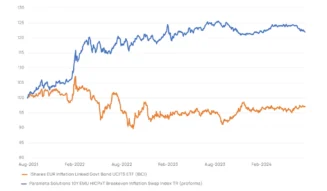
Comparing a hypothetical total return (TR) version of the 10y BISI (reflecting returns on a notional amount from investing the index value in overnight money markets) with that of the ETF since August 2021 presents an interesting perspective. BISI appears to benefit not just from the inherent behaviour of ZCIS in capturing changes in inflation expectations, but also from money market returns as interest rates rose.
Use Cases for Breakeven Inflation Swap Indices
In summary, a systematic rolling investment strategy in ZCIS, such as BISI, provides a comprehensive set of building blocks for market participants to:
- Facilitate the issuance of tracker investment products offering exposure to changes in inflation expectations, at a particular tenor or combination of tenors
- Implement systematic inflation strategies, such as a 2y-10y inflation steepener or flattener, or dynamically switch between the two tenors based on market or other economic signals
- Support performance measurement or attribution of portfolio returns into an inflation expectations component and a real yield element
- Build bespoke benchmarks for portfolios relative to mandates
In the case of a portfolio of inflation swaps that rolls down to maturity over time, as is common in the UK, variants of BISI may be created to mimic that approach. Given the nature of such variants, vintages of indices would need to be developed to support these use cases.
For a closer look at using swaps to hedge specific inflation exposures, read Using Inflation Swaps for a more targeted inflation hedge, and for how expectations vary across tenors, see Inflation curves show why the headline number is only part of the story.
Talk to Our Team
To discuss BISI, inflation swap data or bespoke index variants with Parameta’s indices team, contact us.
Frequently Asked Questions
What is breakeven inflation?
Breakeven inflation is the market-implied expectation of average inflation over a set period. It is measured as the difference between the yield on a nominal government bond and an inflation-linked bond of the same maturity, or as the fixed rate on a zero-coupon inflation swap of that tenor.
What is an inflation swap?
An inflation swap is a derivative in which one party pays a fixed rate and the other pays a rate linked to realised inflation, both calculated on a notional amount. It gives exposure to inflation without needing to fund a bond position.
How is the breakeven inflation rate calculated?
Subtract the yield on an inflation-linked bond from the yield on a nominal bond of the same maturity. For example, a 10-year nominal yield of 2.60% and a 10-year real yield of 0.40% give a 10-year breakeven rate of 2.20%.
What is a zero-coupon inflation swap (ZCIS)?
A ZCIS is the most common type of inflation swap. A compounded fixed rate is exchanged for the cumulative change in a reference price index, with a single net payment at maturity. The fixed rate agreed at the start is the swap-implied breakeven inflation rate.
How does a Breakeven Inflation Swap Index (BISI) differ from an inflation-linked bond ETF?
A BISI tracks the return of an unfunded, monthly rolling zero-coupon inflation swap at a constant maturity, so its performance is driven mainly by changes in inflation expectations. An inflation-linked bond ETF holds physical bonds, so its returns are also heavily affected by moves in real yields and interest rates.
Bibliography
Bibliography
1 Fisher equation – Wikipedia
Read SourceDisclaimer
© 2026 ICAP Information Services Limited (“IISL”). This communication is provided by ICAP Information Services Limited or a member of its group (“Parameta”) and all information contained in or attached hereto (the “Information”) is for information purposes only and is confidential. Access to the Information by anyone other than the intended recipient is unauthorised without Parameta’s prior written approval. The Information may not be not used or disclosed for any purpose without Parameta’s prior written approval, including without limitation, storing, copying, distributing, licensing, selling or displaying the Information, using the Information in an application or to create derived data of any kind, co-mingling the Information with any other data or using the data for any unlawful purpose of for any purpose that would cause it to become a benchmark under any law, regulation or guidance. The Information is not, and should not be construed as, a live price, an offer, bid, recommendation or solicitation in relation to any financial instrument or investment or to participate in any particular trading strategy or constituting financial or investment advice or a financial promotion. The Information does not constitute a public offer under any applicable legislation or an offer to sell or a solicitation of an offer to buy any securities. The Information is not to be relied upon for any purpose whatsoever and is provided “as is” without warranty of any kind, either expressly or by implication, including without limitation as to completeness, timeliness, accuracy, continuity, merchantability or fitness for any particular purpose. All representations and warranties are expressly disclaimed, to the fullest extent possible under applicable law. In no circumstances will Parameta be liable for any indirect or direct loss, or consequential loss or damages including without limitation, loss of business or profits arising from the use of or any inability to use the Information, or any inaccuracy in the Information. Parameta may suspend, withdraw or modify or change the terms of the provision of the Information at any time in its sole discretion, without notice. All rights, including without limitation intellectual property rights, in and to the Information are, and shall remain, the property of IISL or its licensors. Use of, access to or delivery of Parameta’s products and/or services requires a prior written licence from Parameta or its relevant affiliates. The terms of this disclaimer are governed by the laws of England and Wales.